


Quick answer
Use matt tiles on the floor, granite or sealed marble where the lamp sits, one feature on the back wall (patterned tiles, a stone slab or a backlit jali) and a plain light ceiling with one warm light and a vent. In Bangalore in 2026, designer wall tiles cost about ₹115 to ₹310 per sq ft with laying, and granite cladding about ₹250 to ₹500 per sq ft installed.
The best pooja room tiles are matt on the floor and marble-look or patterned on the back wall, with granite or sealed marble where the lamp sits and a plain, light ceiling with one warm light and a vent. In Bangalore in 2026, designer wall tiles cost about ₹115 to ₹310 per sq ft with laying and granite cladding about ₹250 to ₹500 per sq ft installed.
This guide is about the surfaces. For direction, sizes, doors and the unit itself, see our pooja room design guide.
Which material for which surface
| Surface | What works |
|---|---|
| Floor | Matt vitrified tiles, granite or honed marble; not glossy, because oil makes it slippery |
| Lamp and idol platform | Granite or sealed marble, 18 to 20 mm thick; never bare wood or laminate |
| Back wall | Patterned tiles, a stone slab, a backlit jali or fluted panel: one of them, not three |
| Side walls | Plain tiles or washable paint in a light colour |
| Steps | The same stone as the platform, with rounded edges |
| Ceiling | Plain POP or gypsum with one warm light; a panel above the lamp you can repaint |
| Top (gopuram or arch) | Wood, MDF with PU paint, POP or carved marble |
Pooja room tiles design
| Tile | Where to use it |
|---|---|
| Marble-look vitrified, 2 x 4 ft | Back and side walls; few joints, easy to wipe |
| Patterned or lotus ceramic, 12 x 12 in | A border or the panel behind the idols |
| Mosaic | A niche or a thin band; hard to clean over a large area |
| Matt vitrified, 2 x 2 ft | Floor |
| Textured or 3D tile | Side walls; not behind the lamp, where soot settles in the grooves |
| Tiles with god images | A wall panel only, never the floor or a step |
- Pooja room tiles colour: white, cream, light yellow and soft beige suit brass and are the colours Vastu prefers. Families who follow it avoid black and dark grey.
- Texture: smooth on the wall behind the lamp, matt on the floor.
- Joints: 2 mm, with epoxy grout near the lamp, so oil does not stain them.
- A golden border works once, round the idol panel. Repeated round the room it looks busy.
- Buy two or three spare tiles for later repairs.
Granite and marble design for a pooja room
| Granite | Marble |
|---|---|
| Takes heat and oil without marking | Stains from oil and turmeric unless sealed |
| Hard, so carving is limited | Carves well: pillars, arches, a gopuram |
| Colours: red, brown, green, grey, black | White and cream, the traditional look |
| ₹250 to ₹500 per sq ft installed, as cladding | ₹150 to ₹900 per sq ft installed, as flooring |
| Wipe daily; no polish needed for years | Seal once a year; use a tray under the lamp |
- Granite slab design: one full slab on the back wall, with the veins running upward, looks calmer than small pieces.
- Ask for the slab, the platform and the steps from the same lot, so the colour matches.
- Keep the platform edge rounded, and let it stand 1 inch past the steps so oil drips clear.
Pooja room steps design
- Idol steps: 3 or 5, each 4 to 6 inches high and 8 to 10 inches deep. Odd numbers are traditional.
- Entry step or threshold: one step, 4 to 6 inches high and at least 12 inches deep.
- Make the top step deep enough for the largest idol and its frame, with 2 inches behind it.
- In a small pooja room, use two idol steps and a drawer inside the lower one.
Pooja room wall and background design
| Background | Notes |
|---|---|
| Patterned tile panel | The cheapest that wipes clean; frame it with plain tiles |
| Single stone slab | Best near a lamp; needs a strong wall |
| Backlit CNC jali | Leave 1.5 to 3 inches behind it for the light; matt paint on the wall behind |
| Fluted or wooden panel | Warm and modern; keep it 12 inches from the flame |
| Carved panel or Om motif | One motif, centred on the idol; CNC-cut board or solid wood |
| Textured paint | Side walls; hard to clean behind a lamp |
| Wallpaper | A side wall or outside the niche only |
- Wallpaper for a pooja room: choose washable vinyl, and never put it on the wall behind the lamp or above it.
- Centre the background on the idols and stop it at the same width as the platform.
- Put the light above or behind the idols, not in front, so the frames do not glare.
Pooja room design in wood
- Veneer or laminate on BWP plywood for the unit, and solid wood for carved parts and the frame.
- Seal every edge near the platform, where water and oil collect.
- Carving: solid wood for deep carving; 12 or 18 mm MDF or HDHMR with CNC cutting for flat patterns.
- Keep wood and fabric at least 12 inches away from a flame.
Get a layout plan for your room.
Pooja room ceiling and POP design
| Ceiling | When to choose it |
|---|---|
| Plain POP with a cornice | Small pooja rooms and niches |
| One recessed square or circle with a cove | Rooms of 5 x 5 ft or more with a 9 ft ceiling |
| Round dome | Independent houses with 10 ft or more |
| Lotus or mandala motif in POP | Over the idols, in relief; keep the rest plain |
| Backlit jali panel | When the lamp is not below it |
| Wooden ceiling or slats | Traditional rooms; never above a lamp |
- Small pooja room POP design: a border 6 to 9 inches wide, one warm downlight, and no second level.
- Leave a vent or an exhaust in the ceiling or high on the wall. Soot marks a closed POP ceiling within months.
- Paint it in washable white or cream, so you can wipe and repaint the part above the lamp.
- One warm light of 2700K to 3000K, on a switch outside the door.
Gopuram and arch design
- Gopuram: a stepped top in the shape of a temple tower, above the unit or the door. It suits a height of 12 to 18 inches in a flat.
- Leave 3 to 4 inches between the gopuram and the ceiling, so it can be dusted.
- Arch: a plain arch suits modern homes; a three or five-curved arch on two pillars looks traditional.
- Match the arch's width to the platform, not to the wall.
- Pooja room top design for a small unit: a flat canopy with one brass edge, or a shallow carved arch. A tall gopuram looks heavy above a 2-foot unit.
- Choose one carved part: the arch, the gopuram or the doors.
Pooja room tiles, granite and ceiling cost in Bangalore (2026)
| Item | Price |
|---|---|
| Ceramic wall tiles | ₹40 to ₹100 per sq ft, plus laying |
| Designer or glazed vitrified wall tiles | ₹80 to ₹250 per sq ft, plus laying |
| Laying | ₹35 to ₹60 per sq ft |
| Granite cladding, installed | ₹250 to ₹500 per sq ft |
| CNC jali, MDF with PU finish | ₹300 to ₹800 per sq ft |
| Fluted MDF or veneer panel | ₹900 to ₹1,800 per sq ft |
| Wallpaper, installed | ₹40 to ₹110 per sq ft |
| POP ceiling, plain | ₹65 to ₹120 per sq ft |
| POP ceiling with a cove | ₹90 to ₹160 per sq ft |
| LED strip with driver | ₹120 to ₹250 per running ft |
| Part | Cost |
|---|---|
| Back wall, 48 sq ft, in designer tiles | ₹5,500 to ₹14,900 |
| The same wall in one granite slab | ₹12,000 to ₹24,000 |
| Granite floor, 30 sq ft | ₹7,500 to ₹15,000 |
| Three granite steps, 4 ft wide, about 16 sq ft | ₹4,000 to ₹8,000 |
| POP ceiling with a cove, 30 sq ft | ₹2,700 to ₹4,800 |
| LED strip, 22 ft | ₹2,600 to ₹5,500 |
Small rooms often carry a minimum charge, so ask for a lump sum as well as a rate. Edge polishing, wiring and carved parts are extra; carved wood, marble and gopuram work is priced per piece, from a drawing.
Common mistakes
- Glossy floor tiles, where oil and water spill every day.
- Wood, laminate or wallpaper behind or above the lamp.
- White marble left unsealed.
- Sacred images on floor tiles or steps.
- A patterned wall, a carved arch and a mandala ceiling in one small room.
- A closed ceiling with no way out for smoke.
- Steps too shallow for the idols the family already owns. Measure them first.
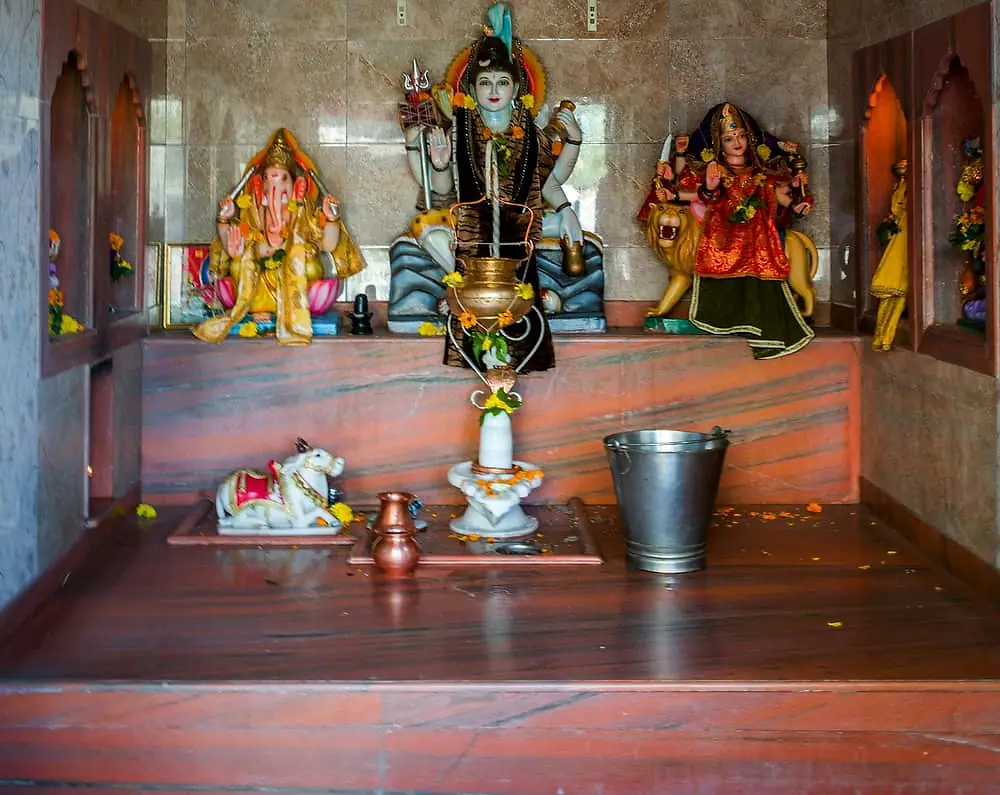
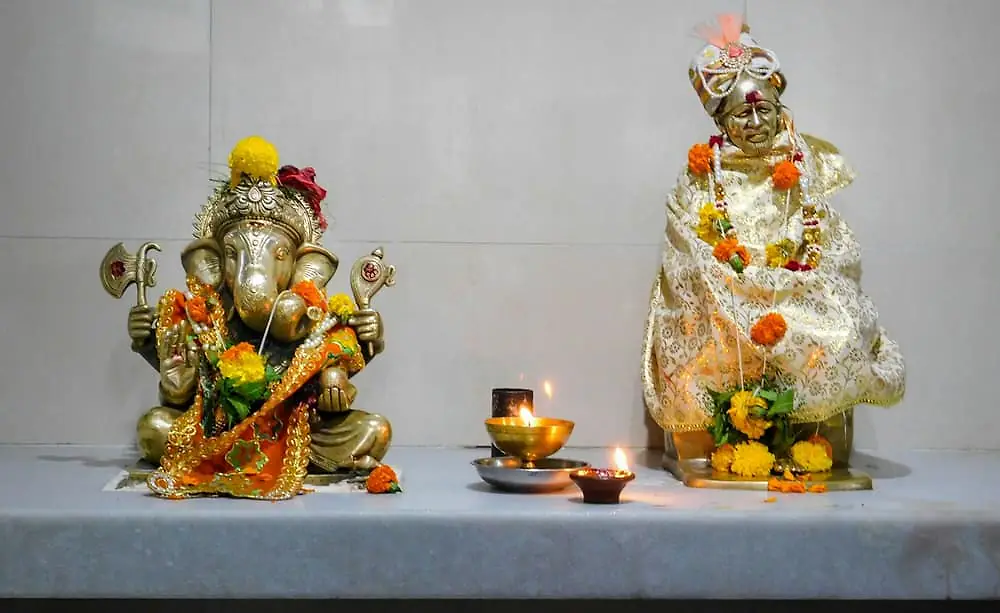
What granite, marble and tiles look like
Example photos for reference, not YellowDot projects. Each one's credit is under it.
Book a free consultation with YellowDot Design Studio. We plan the pooja room with your floor plan and show the stone, wall and light in 3D before work starts. See how we plan interiors for Bangalore homes.
We design home interiors in Bangalore for flats and villas across the city, including Jayanagar and Whitefield.
See the pooja room before you choose the stone