


Quick answer
WPC stands for wood-plastic composite. WPC board is made mainly of PVC mixed with wood flour or fibre, so it does not absorb water, rot or get eaten by termites. Use it in bathrooms, sink units and door frames, and plywood where you need strength and long spans.
Below: what WPC stands for and what the board is, how it compares with PVC and plywood in Indian conditions, the thicknesses, prices per sq ft and where it makes sense in a Bangalore home.
WPC board has become a common answer to an old problem in Indian homes: wood and plywood that swell, rot or get eaten by termites in wet places. Bathroom vanities, kitchen sink units, door frames and balcony cabinets that used to fail in a few years can now be built in a material that does not absorb water at all.
It is not a replacement for plywood everywhere, though. WPC has real limits in strength and screw holding, and using it in the wrong place causes its own problems.
WPC full form and meaning
WPC full form: Wood Plastic Composite, also written wood-polymer composite. A WPC board, also sold as a WPC sheet or WPC foam board, is a flat sheet of that composite, used in place of plywood where water and termites are the problem.
What WPC board is
The boards used in interiors are made mainly of PVC mixed with wood flour or fibre, often foamed to reduce weight, and pressed into sheets.
Because it is mostly plastic, WPC does not absorb water, does not rot and is not attacked by termites. It is also dimensionally stable in humidity, which means it does not swell in the monsoon.
| Name | What it is |
|---|---|
| WPC board, WPC sheet | Flat sheets for cabinets, vanities and doors |
| WPC foam board | A lighter, foamed sheet of the same material |
| WPC door frame | A frame that can stand on a wet bathroom floor |
| WPC wall panel, WPC louvers | Profiled strips for cladding walls |
WPC vs PVC vs plywood for Indian homes
| WPC board | Foam PVC board | BWP plywood | |
|---|---|---|---|
| Made of | PVC with wood flour or fibre | Foamed PVC | Wood veneers bonded with waterproof glue |
| Water | Does not absorb it | Does not absorb it | Resists it if the edges are sealed |
| Termites | Not attacked | Not attacked | Can be attacked |
| Monsoon humidity | Does not swell | Does not swell | Stable if sealed |
| Strength and screw holding | Better than foam PVC, below plywood | Weakest | Best |
| Heat and sun | Expands slightly, fades outdoors without UV protection | Softens with sustained heat | Stable |
| Price per sq ft, 16 to 18 mm | Rs 120 to Rs 200 | Rs 85 to Rs 115 | Rs 130 to Rs 220 |
| Best for | Bathrooms, sink units, door frames | Sink bases, light cabinets | Long spans, heavy loads |
The foam PVC price is a dealer listing price checked on 2 November 2026. For how PVC behaves in a kitchen, see PVC kitchen cabinets.
WPC vs plywood
Choose WPC where water and termites are the main risk: bathrooms, sink units, door frames and utility cabinets.
Choose BWP or marine plywood where you need strength, screw holding and long spans, and water exposure is occasional rather than constant.
Many kitchens use both: WPC or BWP for the sink unit, and plywood or HDHMR for the rest.
WPC limitations
WPC is softer than plywood. It dents more easily under impact and can scratch.
It holds screws less firmly, especially near edges. Use screws designed for WPC, pre-drill, and avoid fixing heavy loads to edges.
It sags over long spans. Shelves longer than about 24 inches carrying heavy items need a support or a thicker board.
It expands slightly with heat. Large WPC panels in direct sun need small gaps at joints.
It is heavier than plywood of the same thickness for many grades, which affects hinge choice on large doors.
It is not ideal for structural parts such as bed frames or heavily loaded bookshelves.
WPC board thickness and sizes
| Thickness | Use it for |
|---|---|
| 6 to 8 mm | Cabinet backs |
| 12 mm | Light doors and panels that carry no load |
| 16 to 18 mm | Carcass sides, shelves, vanities |
Sheets are commonly sold in 8 by 4 feet. Wall louvers come as long strips, often 8 to 10 feet long.
Thickness and grades
Common thicknesses are 6, 8, 12, 16 and 18 mm. Use 16 to 18 mm for carcass sides and shelves, and 6 to 8 mm for backs.
Density varies by brand. Denser boards hold screws better and sag less, but cost more and weigh more. Ask for the density and check samples.
How to check WPC quality
Ask for the board's density and compare samples by weight and stiffness. A board that flexes easily in your hands will sag as a shelf.
Check the surface for an even finish without pits, and cut edges for a uniform, closed-cell structure rather than large holes.
Ask whether the board contains recycled filler. Some low-priced boards use more filler and less PVC, which makes them brittle.
Pick finishes that suit Bangalore's weather.
Where WPC makes sense in a Bangalore home
| Place | WPC? | Why |
|---|---|---|
| Bathroom vanity | Yes | Splashed every day without swelling |
| Kitchen sink unit | Yes | Leaks and spills damage plywood first |
| Bathroom door and frame | Yes | The bottom of the frame often stands in water |
| Balcony and utility cabinets | Yes, with UV protection outdoors | Rain, humidity and washing-machine leaks |
| Wall panelling | Yes | Does not swell on damp walls |
| Main door | No | Lacks the weight and strength most families expect |
| Bed frames, loaded bookshelves | No | Not ideal for structural parts |
Where WPC works well
Bathroom vanities and cabinets are the most common use. A WPC vanity can be splashed every day without swelling.
Kitchen sink units, where leaks and spills damage plywood first, are another good use, either the whole unit or the base panel.
Door frames and doors for bathrooms, where the bottom of the frame often stands in water. Balcony and utility cabinets, which face rain, humidity and washing-machine leaks. Areas with termite history, such as cabinets on ground floors of older houses.
WPC wall panels and louvers
WPC wall panels come as flat panels, fluted panels and louvers, the slatted strips used behind TVs, beds and in entrance walls. Because the material does not swell, they suit walls that get damp, bathroom feature walls and covered balconies.
Louvers are sold as long strips, often 8 to 10 feet long, in a range of thicknesses and wood-grain finishes. Fitted, WPC panelling usually costs about Rs 200 to Rs 600 per sq ft, depending on the profile, the finish and the wall. For design ideas, see our guides to fluted panels and louvers.
WPC for doors and frames
WPC door frames are one of the most useful applications. In bathrooms, the bottom of a wooden frame often stands in water and rots within a few years. A WPC frame does not, and it can be fixed directly on the floor.
WPC doors are waterproof and termite-proof, and are available laminated or with printed wood grain. They suit bathrooms, utility areas and terrace doors. For main doors, they lack the weight and strength most families expect, so solid wood or engineered doors remain the better choice there.
WPC outdoors
On balconies and terraces, WPC is used for cabinets, benches and decking. Choose boards with UV protection, since sunlight can fade or chalk the surface over time, and leave small expansion gaps between panels, as WPC grows slightly in the afternoon heat.
WPC board price per sq ft in Bangalore
In 2026, WPC board costs about Rs 120 to Rs 200 per sq ft for 16 to 18 mm sheets in Bangalore, depending on density and brand. Thinner boards cost less.
| Item | Price |
|---|---|
| WPC board, 16 to 18 mm | Rs 120 to Rs 200 per sq ft |
| WPC wall panels and louvers, fitted | About Rs 200 to Rs 600 per sq ft |
| WPC bathroom vanity | Rs 12,000 to Rs 35,000 |
| WPC bathroom door | Rs 6,000 to Rs 15,000 |
A WPC bathroom vanity typically costs Rs 12,000 to Rs 35,000 depending on size and finish. A WPC bathroom door costs about Rs 6,000 to Rs 15,000. The wall panel range comes from dealer listings and industry price guides checked on 2 November 2026.
WPC installation and common mistakes
Finishes on WPC
WPC can be laminated, but it needs an adhesive suited to PVC surfaces. Ordinary adhesives can fail and let laminate peel. Ask your vendor what adhesive they use.
It can be painted with PU or duco finishes, and some boards come pre-finished or with a printed wood grain.
Edges can be left plain, since they do not need sealing against water, or edge-banded for appearance.
Mistakes to avoid
Using WPC for long, heavily loaded shelves is the most common. They bow within months.
Using ordinary laminate adhesive is the second. The laminate lifts at the edges.
Fixing heavy hinges near the board's edge without the right screws is the third. The screws loosen over time.
Caring for WPC furniture
WPC needs very little care. Wipe it with a damp cloth and a mild detergent. Avoid strong solvents, which can mark the surface, and do not place very hot vessels directly on it.
Check hinge screws once a year and tighten them if needed, since WPC can let screws loosen slightly over time.
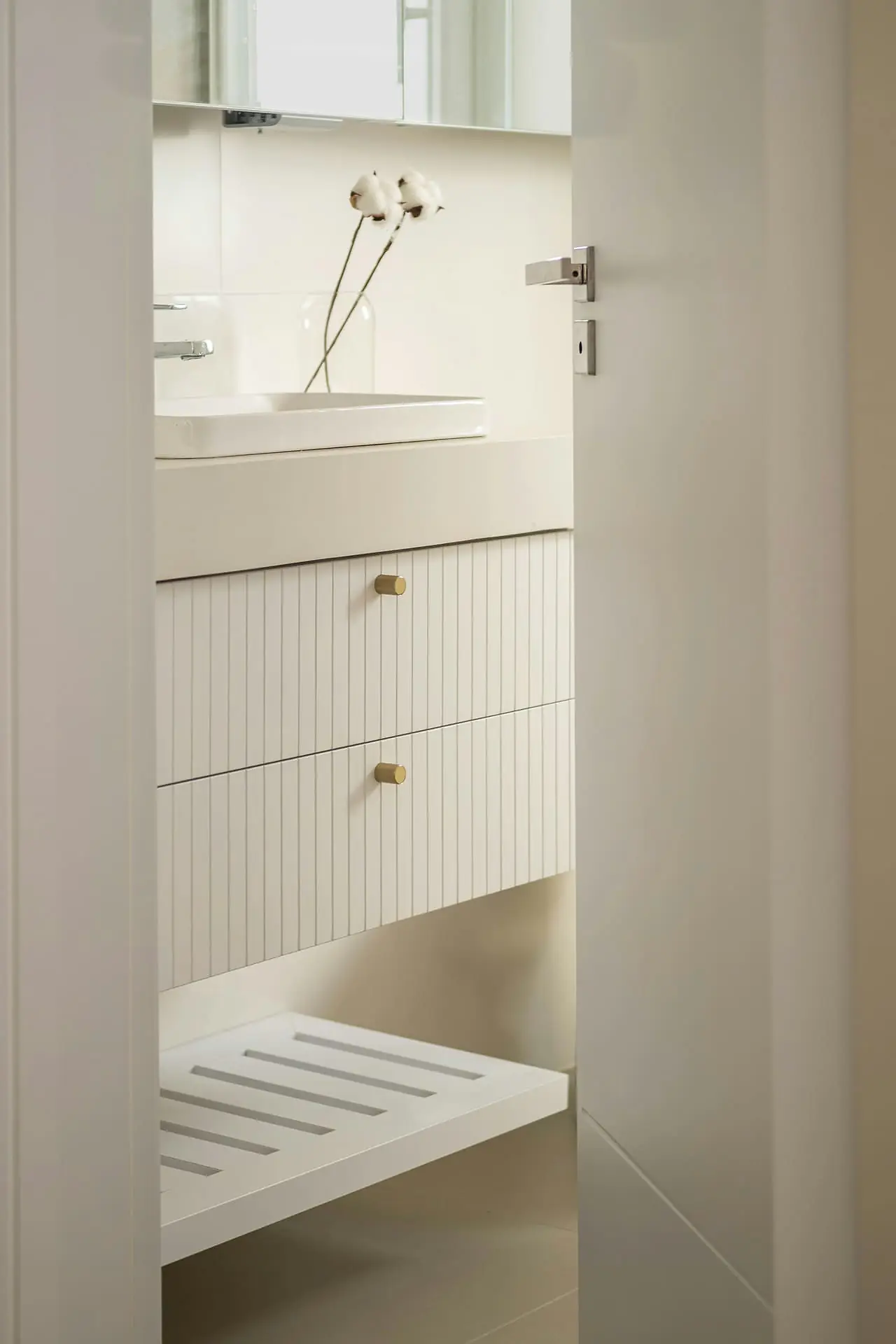
Vanity and wall panel examples
Example photos for reference, not YellowDot projects. Each one's credit is under it.

Book a free consultation with YellowDot Design Studio. We pick the right board for each part of your home, with every material named in the quote. See how we plan interiors for Bangalore homes.
We design home interiors in Bangalore for flats and villas across the city, including JP Nagar and Kanakapura Road.
Use WPC where water is the real risk